
Riftbound's Magic Tournament: A Stuttgart Retrospective
11/23/2026
Two weeks ago, I played in the highest-stakes card game tournament I've ever played in - Riftbound's first Regional Championship in Stuttgart. It was also the most I've won from playing card games, especially given that I "only" came in 40th. Turns out, an Overnumber Foil Plated Orianna I drafted from the top 58 draft is expected to be worth more than I've ever gotten for winning or top 8'ing any Magic tournament.
This insane prizing has been fairly par for the course for Riftbound. I may not understand what exactly drives people to spend so much on these collectibles; but I'm certainly not going to look a gift horse in the mouth. But what was unique to this tournament specifically was the structure - where previously, all of the Regional Qualifiers gave these high-value cards only to best-of finishers; this time the main incentive by far was to simply play the deck that would be best for winning all your matches. When the biggest prize by far is the Overnumber Foil Plated Ahri that undoubtedly goes to 1st place, 1st place is where you should be aiming.
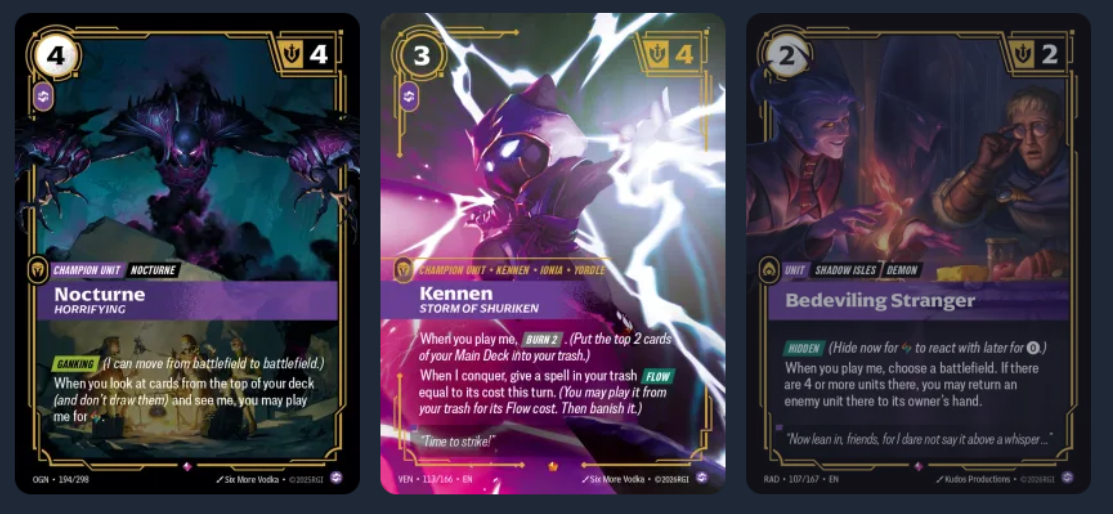
So, for basically the first time in Riftbound's history, we had an extremely condensed metagame. Now, some of this could be blamed on the exact details of the meta - Riven as a deck is very obviously strong, and extremely consistent in that strength. And Kennen was also pretty obviously still one of the top decks, now that it could use
Trifarian Captain to hit Nocturne fairly consistently. But none of this was particularly special - you could argue that neither of these two decks were even as strong as the original pre-ban Kennen deck that played Stacked Deck, and that did not reach higher than 15% Kennen at RQs.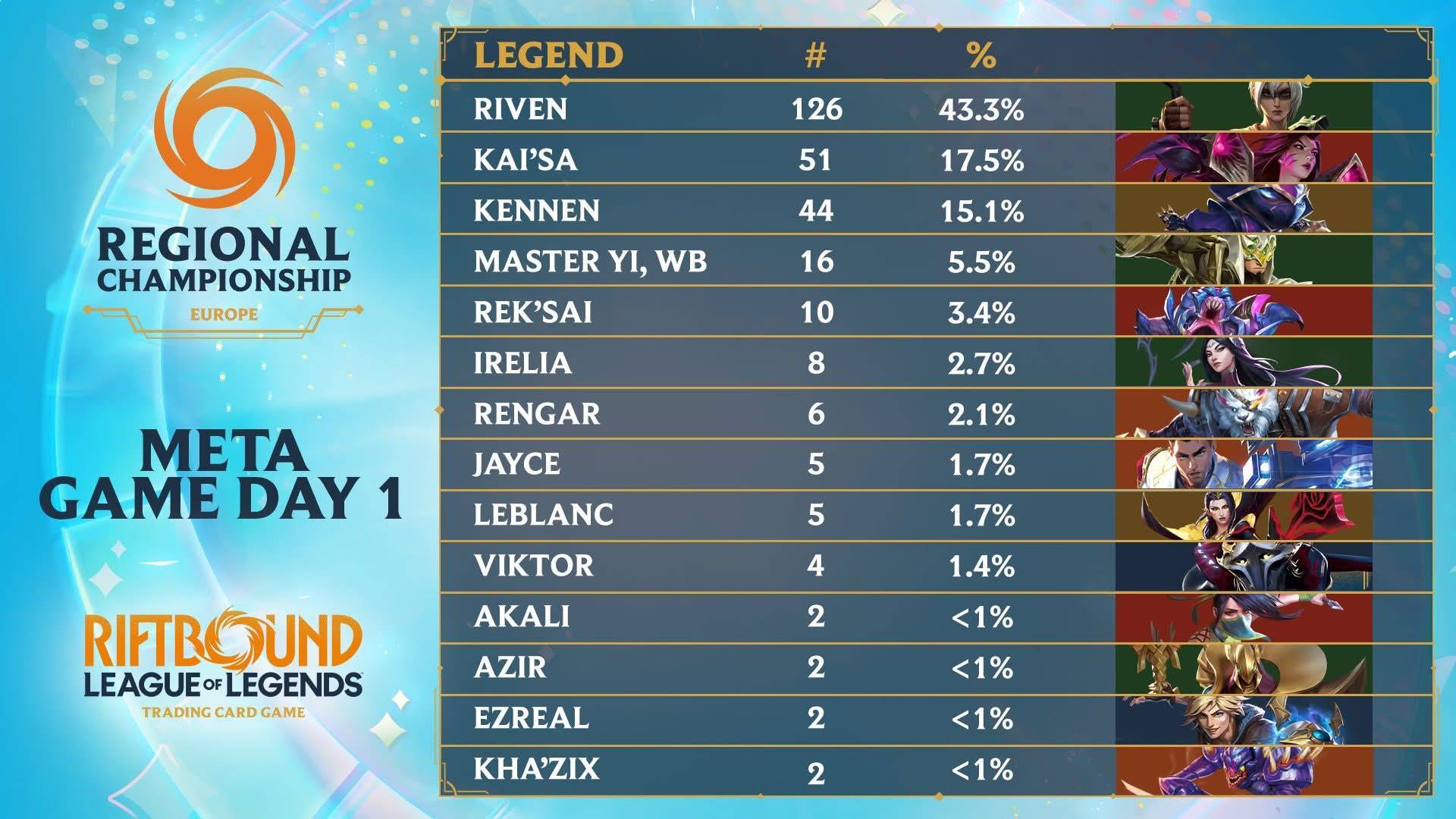
Now, while this kind of tournament was new to Riftbound, it is extremely familiar to any competitive Magic player. And honestly, this is part of my theory for why many players lauded as the best in the world (like Prismaticism and Squirtle) did poorly in the tournament; while the group I tested with that consisted largely of Magic players ended up doing extremely well, with me placing 40th, Allen placing 11th, and Evan winning the entire tournament! Plus, our group even had a bunch of smaller achievements with the list, with Dan Weiser getting to the top 8 of the Nation Clash, and then Evan winning the Gen G showdown (again) two weeks later as I'm writing this very article.
The Team
Brief aside about the group I worked with this time - it was a combination of Aspirant's Climb, the three of us on Team Baddies (me, Arya, and Bloody), and a couple other of Arya's coworkers from WotC. I'm hoping that in the future we can expand Team Baddies to be a fuller testing team than just the three of us, but for now I have enjoyed working with Aspirant's Climb.

Bloody, me, and Arya at Stuttgart before the tournament
So, let's talk about what happened. How did we arrive at Kennen as the deck to register? What were our plans for fighting this metagame? And what can we learn from this for future similarly structured Riftbound tournaments?
Part 1: Metagame
The first question we had to answer is what we expected to see out of the meta. Usually at RQs, even the strongest and most popular decks only get to 15% at most. But with very minimal incentives for competing for best-ofs, the RC would be clearly be a lot more concentrated. The real question was: by how much?
In the weeks leading up to the RC, it became very clear that Riven was the default "best deck". It was the most popular deck at Showdowns in Melbourne, Sacramento, and Orlando; and also was the best performing popular deck at each of them, winning >60% of its matches and taking home the trophy in two of them. Similarly, Kennen and Kai'Sa trailed behind by only a little bit both in popularity and winrate at both Sacramento and Orlando, as two historically strong existing decks that both got
huge upgrades from Radiance.So these were clearly going to be the big three decks going into the weekend, with Riven being the clear favorite. We decided that we would probably expect to see a similar shaped spread at the RC, but scaled up to be a much larger fraction of the meta. A lot of us pulling from Magic Pro Tour experience predicted Riven would get up to around 30-40% - somewhere between Esper Midrange at PT OTJ and Izzet Prowess at PT FIN. Ultimately it ended up slightly more popular than that, but close enough that I would say our predictions were quite accurate.
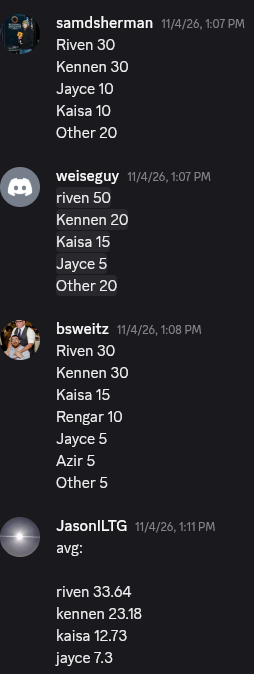
we ran a wisdom-of-the-crowd poll to get a sense of what our meta prediction was, which underestimated Riven a little and overestimated the other decks a bit but did okay.
Now, the public data from showdowns seemed to indicate that among these top 3, Kennen was beating Riven; Riven was beating Kai'Sa; and Kai'Sa was beating Kennen, all at about 60-40 clips. If you believed in this dynamic exactly, then that would make Kennen look like a nice deck to look at, as in a pure Rock-Paper-Scissors you would like to be playing the part of the RPS that's good against the most popular deck. But that's not at all the whole story - there are other decks to think about outside of the top 3, and public data is very prone to just being flat wrong.
Part 2: Rock Paper Scissors?
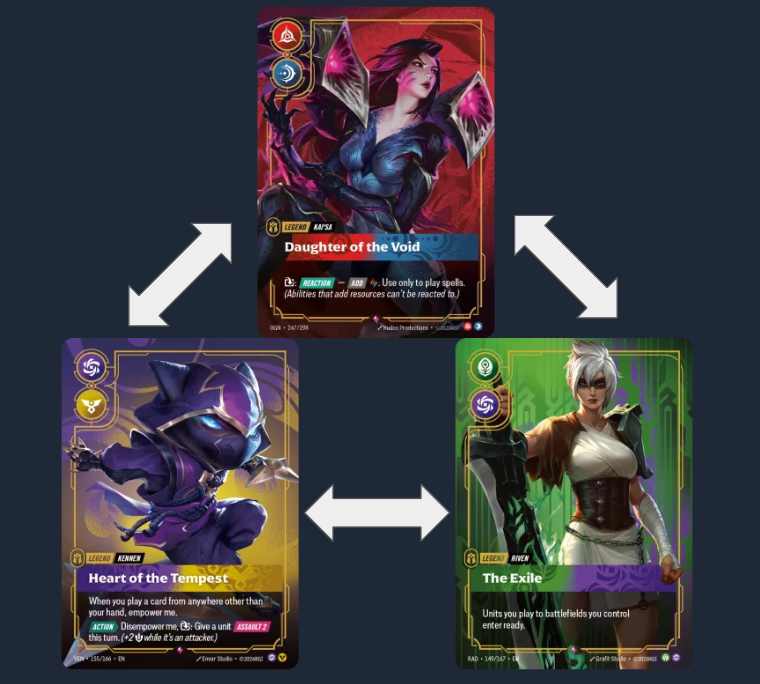
As we started testing matchups, the first thing we concluded was that all of the public data was in fact just wrong. At some point, we even thought that the top 3 RPS went in the exact opposite direction as public data suggested! (Kai'Sa beating Riven, Riven beating Kennen, and Kennen beating Kai'Sa). But mostly, the more we tested, the more we came to conclude that it was all just quite close between all three in all three matchups.
Ultimately, the first deck we all discounted was Kai'Sa. We started pretty hopeful that it would do well into Riven, as Riven is a little bit weak to backline removal decks. And in fact our first couple sets looked pretty promising! But as our Riven decks developed and our Riven pilots got better at playing the matchup, we started seeing a lot of cracks in the base consistency of the Kai'Sa deck itself. And we were still extremely confident that our Kennen decks, and well-built/piloted Kennen decks in general, would definitely be able to defeat Kai'Sa. So, we dropped it.
Of course, the best-performing Kai'Sa decks ended up improving on the consistency issues we were having by registering three 2-drops (as opposed to the zero or six that our lists had been playing) and more copies of
The Empyrean. It's unsurprising that the versions people did well with ended up more refined than our early testing lists. But I still believe that we were correct to abandon Kai'Sa early. Even with these improvements, it was just clear that it wasn't going to be truly amazing overall into the meta, and at best okay. And narrowing down the "big 3" to just 2 made things a lot more workable.So that left us with Riven and Kennen. How do we decide between those?
Well, I focused much more on developing the Kennen side than the Riven side, so I don't have that much expertise on our Riven labbers' exact thoughts. I know that we tried many things, from weird builds with
Angler Wyrm to experimenting with battlefields, Blitzcrank, and Baron Nashor. But ultimately nothing really seemed like a huge advancement per se - we especially couldn't really figure out how to truly break open the mirror. And while there were small edges to get on card choices, the "stock" Riven deck just seemed like it was clearly the best structure for the deck.Meanwhile, our Kennen exploration felt a lot more promising. We had a couple directions to explore - mainly with
Tornado Warrior and Tail-Cloaked Matriarch and without - and it felt like the small card choices mattered a lot, because you just had so much access to finding even specific 1-ofs in your deck, especially if you could find them off of Trifarian Captain.Ultimately, I think the choice that many of us made to register Kennen over Riven was less about which we expected to be favored in the head-to-head matchup (we thought it was pretty even and much more dependent on skill and familiarity than on which deck you were playing); and more about two specific factors:
1) We thought that the edge we could get with Kennen was higher than the edge we could get with Riven. It felt like our Kennen lists made significant improvements in ways that would play better and notably differently from what others in the tournament expected from Kennen, and that we could leverage that information differential to get ahead. Meanwhile Riven struggled to be improved ironically because of how consistent it was - the normal curve of 2 drop into Riven into eventually playing a Heron was just such a dominating part of the power of the deck that the other cards in the mix just mattered less on average.
2) Most of all, we felt that Riven was very exploitable. There were just many less popular decks that were actually ery good into Riven, at the expense of being a little less good into the meta at large. At some point we seriously considered Jayce, even though its Kennen matchup was nigh unwinnable, just because of how well it did into Riven. And Jun ultimately ended up switching to Kha'Zix only a few days before the tournament because he thought the Riven matchup was literally 80% in his favor. Meanwhile, Kennen's sheer raw power of might that it could output on command and consistent access to purple spells meant that there just was no way in the format to exploit Kennen.
Put simply, while Kennen and Riven looked somewhat similar in winrate against the top of the metagame, Kennen's winrate into the random other decks was a lot more robust. While we didn't expect to see that many Jayce or Kha'Zix or what have you, it was a serious possibility - after all, Jayce had been the highest winrate deck at some of the Showdowns ahead of Stuttgart. And while this wouldn't necessarily be enough to sway us if we thought that Riven was better than Kennen in other ways, it served as a pretty damning tiebreaker.
Part 3: Kennen
And so, we landed on Kennen. We had a lot of disparate thoughts on Kennen, so I think it's best to structure this section just by going over each of those takeaways one-by-one, talking through how we got to each one. This won't be as structured as a complete guide, as that won't be particularly useful given the imminent bans. Instead, I hope to expose more of the processes and thoughts that helped us reach the conclusions we did.
Tornado Matriarch
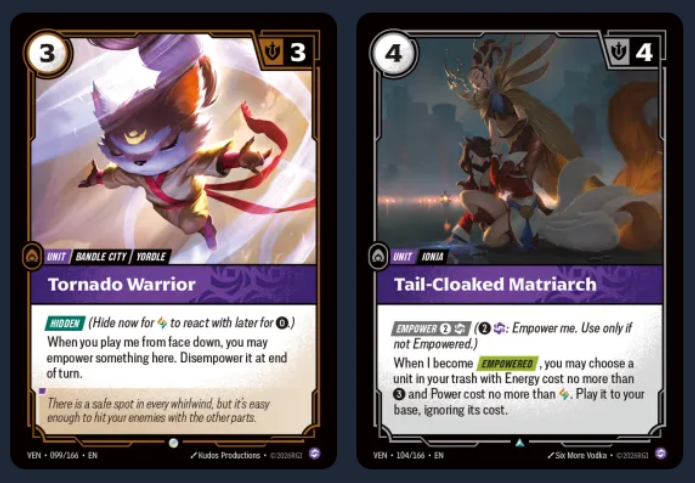
By far the biggest question we had in building our Kennen deck was whether the Tornado Matriarch combo was worth playing. It was undeniably powerful when it worked - you got to pay 4 energy and 1 power to get approximately 10 might of stats and probably also trigger some nice ability from the unit you get back. And then if your opponent doesn't successfully trade with your Matriarch, you can re-empower it on a following turn, possibly with another Tornado Warrior, or with the same one bounced by
Star-Crossed.This was the best way to build the deck in set 4, and while set 5 brought back a lot of other power in the form of
Nocturne, it also improved Tornado Matriarch by increasing its consistency with Trifarian Captain. Not only did the card find your Tornados and your Matriarch hits more consistently; it also functioned as an actually somewhat reasonable card to get back with Matriarch. While it didn't have that much board impact on its own, it dug towards more ways to keep running the Matriarch engine, while also digging you further towards any Nocturnes in your deck.We also got a couple more good Matriarch hits.
Bedeviling Stranger served as a really powerful hidden card that helped provide a strong hidden mix, while also being a strong card to get back at reaction speed with Tornado Matriarch, letting you affect either battlefield. And the presence of wider boards with Captain and Nocturne made Xin Zhao a very nice one-of accelerate unit to have with Matriarch.All of these new tools were nice for sure. And fundamentally the Tornado Matriarch strategy of repeatedly forcing your opponent to run into your low-cost high-output holds was greatly helped by the addition of more free might in the form of Nocturnes. It was also just nice to have another avenue for high-roll potential, as the return of Nocturne made the deck higher variance. Adding another bullseye to the dartboard in addition to "put Nocturnes into play" or "use Lightning Rush to power out Rhasas" was quite appealing. But there were definitely problems.
First of all, the whole Tornado Matriarch package just took a lot of space. Our final Tornado Matriarch builds were playing 3 Matriarchs, 2 Tornados, and 2 other units we wouldn't otherwise play to serve as Matriarch hits (Xin Zhao and
Ezreal, Prodigy). Needing to fit all of those along with adding Nocturnes back into the deck just meant that you were going to be cutting a lot of strong cards to do so. We couldn't fit as much interaction as we wanted, or as many hidden cards as we wanted, or even as many 2s as we wanted. This also made sideboarding lower value, as it was hard to side out a small amount of the Tornado Matriarch package, and there just weren't that many other cards we could realistically side out in many matchups.This wouldn't have been that much of a problem if Tornado Matriarch was actively contributing a uniquely powerful thing. Sure, we would be cutting some strong cards, but that's fine to do if it's in service of even stronger ones. Ultimately though, we decided that Tornado Matriarch didn't quite meet that high bar.
When it worked, it was great! There were definitely many games where it felt a lot stronger than many of the other cards that could have replaced them. And the theory was nice even when things didn't fully work out, as we initially believed that Matriarch was good both for the naturally-grindy mirror, and for building strong 4-might-4-might-hidden holds against Riven. But as we played more, we started to see more and more flaws in those plans.
The biggest hit came as we just started getting higher and higher on
Gust in the format in general. The purple hidden mixup was almost all vulnerable to Gust; and early Gusts were one of the best ways to beat Riven. So the more we played, the more it seemed like everyone should be playing 2-3 Gusts in their Kennen and Riven decks. And while Gust isn't always totally backbreaking against Tornado Matriarch, it is definitely distinctly annoying, with some backbreaking spots.But in addition to that, we just came down on "fair" Matriarch as a plan in general. The 4-4-hidden holds were nice as an answer to a buffed Riven in base, but our plan against Riven started shaping up to be more about trying to deny them that buffed Riven in the first place. And while Matriarchs were definitely good in the postboard
Decree of Unity mirrors, they weren't actually that important to the preboard mirrors.The final nail in the coffin was just playing more with non-Matriarch lists, specifically ones playing
Reckless Innovator. The biggest selling point of Tornado Matriarch was that it provided an additional source of power spiking when your hand was otherwise awkward. But Innovator solved this in a different way simply by helping you smooth out your draws, so your hands were just much less often awkward.Ultimately, we didn't end up playing the Tornado Matriarch build. We didn't even go halfway on it, with most of us registering 0 copies of either card (I think Allen played one Matriarch in the sideboard). But it was definitely a close thing - I was one of the last to abandon them, and did so roughly the day before deck submission.
Edge of Night

I think the biggest innovation that our list had (which was one shared by Gonkra, who also top 8'd) was that we played two copies of
Edge of Night. Remember when I said above that we determined Gust was quite good against almost all purple hidden cards? Well, Edge is basically the one exception, especially with the many 4s that the deck has between Kennen and Nocturne. Edge just gives a large amount of utility for building those cheap holds that are theoretically breakable but much more costly for your opponent to break than they are for you to setup. Where many of the other purple hidden cards help a lot with building bigger holds that are meant to stick, Edge gives you a way to fight smaller, which is a very valuable mixup to have.On top of that, with more access to Seals thanks to Captain, the leftover equipment was also really strong as a might modulation tool. This was especially good into Kai'Sa, as it let you build much more annoying boards for them to clear, and let you do so repeatedly. Edge of Night was almost certainly the biggest reason why we disagreed so much with the public data's claim that Kai'Sa was favored into Kennen.
Riven
Riven was obviously the most important matchup to nail down, even moreso than the mirror. Thankfully, we ended up developing some pretty nice strategies for the matchup. And while we ended up feeling mostly even going into the tournament, I do think that we ended up structurally ahead, largely from just having a good plan.
The natural way to improve your play against Riven specifically was to figure out how to build good holds. Since
Riven's legend doesn't do anything without being on battlefields, one of the best ways to shut the deck down was to simply not let them get onto battlefields. And while this is hard, if you can manage to do so you end up both reaping the natural benefits from holding (scoring points while denying them), while also turning off many of the cards in their deck.The big problem, of course, is their
chosen champion. The natural play pattern for them is to play Riven to a battlefield on turn 2 after conquering with their turn 1 play, and then retreat it. Then, their buffed Riven in base threatens to break battlefields with its stun, or just conquer and retreat for free by readying itself if the stun isn't needed. And holding against a 4 might unit that stuns on attack is just extremely hard. So, we devised 3 strategies to accomplish this:Strategy 1: 4-4-Hidden
The first strategy is to brute force the hold. 4 might plus stun is hard to fend off, but not impossible. Theoretically a single unit that's larger than 4 might can accomplish this, but attempting that is very vulnerable to tricks or additional units, and Kennen doesn't have that many large units, with Rhasa capping out at 6. On the other hand, if you commit two units, you need both of them to have at least 4 might, otherwise the Riven can just run in and eat a 3 might unit for free by stunning the other one. And three units is just too much to realistically consistently have the ability to commit.
So, two 4 might units ends up being a good breakpoint for preventing the Riven from being able to contest without backup. And to fight that backup, a hidden card like Switcheroo or Stranger or even Edge of Night usually was enough to highly discourage the attack. The more we played, the more we started to leverage this 4-4-hidden holding pattern, and it ended up being pretty good. Learning the best shapes of holds for each matchup is generally quite useful, and this was no exception.
However, this plan is certainly not without flaws. There are definitely combinations of cards that can leverage a buffed Riven to beat any 4-4-hidden hold. And, more concerningly, this hold doesn't prevent the Riven from simply conquering the other side and retreating for free. Sometimes that's fine and you get enough value from just holding one side, but often you actually do want to deny both sides, especially on their Heron turn. And you really don't always have the resources to setup two holds of this quality at the same time.
Strategy 2: Gust

So then, we turn to our next strategy: preventing the Riven in the first place. This strategy is really quite simple and obvious, as it just involves gusting their 2 drop so that they cannot play a buffed Riven in base on turn 2. This delays them for at least a turn, and gives you time to setup holds on both sides that are much harder for them to break without a buffed Riven. You can then snowball that advantage to ideally keep them off battlefields perpetually, or at least rack up a huge point differential. But this strategy isn't all that actionable or interesting - mostly it pointed towards playing more copies of Gust, and prioritizing it a lot in mulligans.
Strategy 3: Star-Crossed and Rebuke
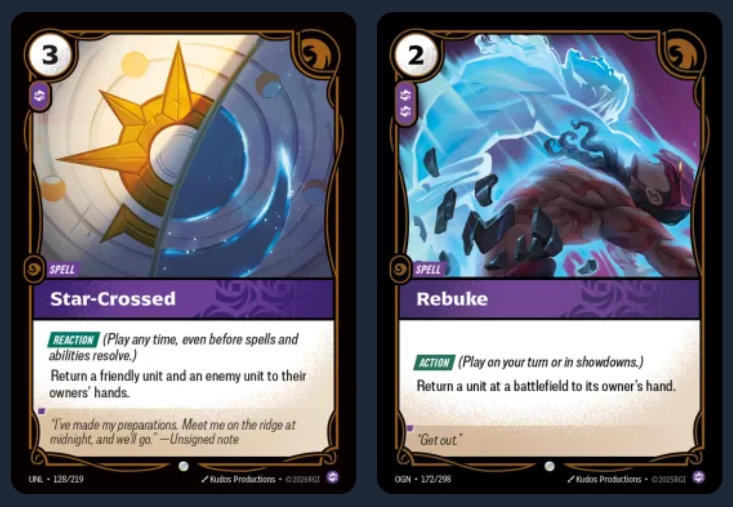
But we can go deeper. This buffed Riven in base kept being really annoying, so it became clear that it was pretty valuable to do everything in our power deal with it. And while we don't get that much removal, we do have access to pseudo-removal in the form of bounce spells. So, at some point in testing, I just started aggressively keeping
Star-Crossed and playing it targeting Riven as soon as it came down. And, it kind of worked! Usually early Star-Crosseds aren't that good, because they are very expensive. But Captain provided a very good target for returning and replaying, especially as each Captain trigger came with some chance at Nocturnes to help push forward the tempo from Crossing.So, we decided to lean more into it. Our final list included 5 bounce spells - 2 Gust, 2 Star-Crossed, and 1
Rebuke - with which our plan was to just repeatedly throw at Riven's early units to bully them off of battlefields while we built big boards. And this plan worked very well - you can see it executed pretty perfectly in Evan's Finals match.Ravenbloom Prefect

The final part of our strategy against Riven was to deal with their best way of getting past our holds without an active Riven - their signature gear,
Blade of the Exile. We could of course hold up An Offer You Can't Refuse, but that required energy investment every turn to hold up, while being Defyable. Instead, we made use of Ravenbloom Prefect as a preventative measure. On important hold turns, having a Prefect safe in your base was a very good way to prevent the possibility of a Blade (barring them having the second one and the resources to pay 6PP for a Blade). It also helped that Prefect had good text against Zhonya's Hourglass too.Conclusion
I could keep going for a while on smaller and smaller Kennen details, talking about our full deck and sideboard and the impetus behind every card. I could talk about how important deck tracking was, or how extra Seal consistency from Captain really affected games. I could even talk about some more theoretical topics, like my wild theory that going second might be legitimately better in the mirror.
But, I have to stop somewhere, and ultimately I've fulfilled my main goal here of covering what I view as the most significant findings that shaped our deckbuilding and deck selection. So, that's the story of how we built the best Kennen deck, which Evan piloted to win the first Riftbound Regional Championship.
The more I think back on that tournament, the more it just truly felt like a Magic tournament to me. Everything lines up so cleanly - the incentives (winning, not best-ofs), the metagame (40/15/15, just like PT Cutter), the prep process (testing house with many Magic players), the decks (Kennen and Riven interact in very Magic-coded ways). And the narrative fits extremely well too - it felt like our team was able leverage our strengths, while some more well-known teams and players (most notably DSG) struggled.
It was a very unique confluence of factors, certainly. Not every Riftbound tournament will be like this - hopefully the bans shake things up for a healthier metagame for Vegas, and certainly non-RC events will still have best-of incentives. I'm excited to see where we go from here, as we continue to push the boundaries of what competing in Riftbound means.

#FreePalestine | Consider donating to UNWRA or PCRF, supporting protesters locally, and educating yourself.